
New Berlin Epoxy Flooring installs basement floor epoxy in New Berlin, WI, serving surrounding cities including Hales Corners, West Allis, Greenfield, Brookfield and Waukesha. After more than 20 years on residential concrete, we treat a basement as a moisture question first and a color question second, because the ground around and under a basement slab decides whether any coating will last.
A well-built basement coating turns cold, dusty concrete into a floor you can actually use for a home gym, playroom, laundry or workshop. It cleans easily, brightens the space and resists the spills and dropped tools that would ruin carpet. Done over an untested slab, it can also blister and peel within a season, which is the failure we spend most of our time preventing.
So every basement quote includes a moisture test, a look at cracks, drains and any old paint, and a straight answer if water is the real problem. Your proposal names the product, every coat and the finished thickness, and a written contract with the products and warranty terms is signed before any deposit is taken.
Moisture Comes First in a Basement
Testing the Slab Before Anything Else
We use the plastic sheet test from ASTM D4263 as a first look, then quantitative testing where it is warranted: calcium chloride testing to ASTM F1869 for vapor emission at the surface, or relative humidity probes set into the slab to ASTM F2170. Manufacturers publish moisture limits for their primers, often referencing thresholds like those in ASTM F710, and the readings tell us which primer can hold.
The test is part of the scope from the beginning, not an extra we sell after a floor has already blistered. If a slab reads too wet for a coating, we tell you before you have paid for one.
Condensation Versus Vapor From Below
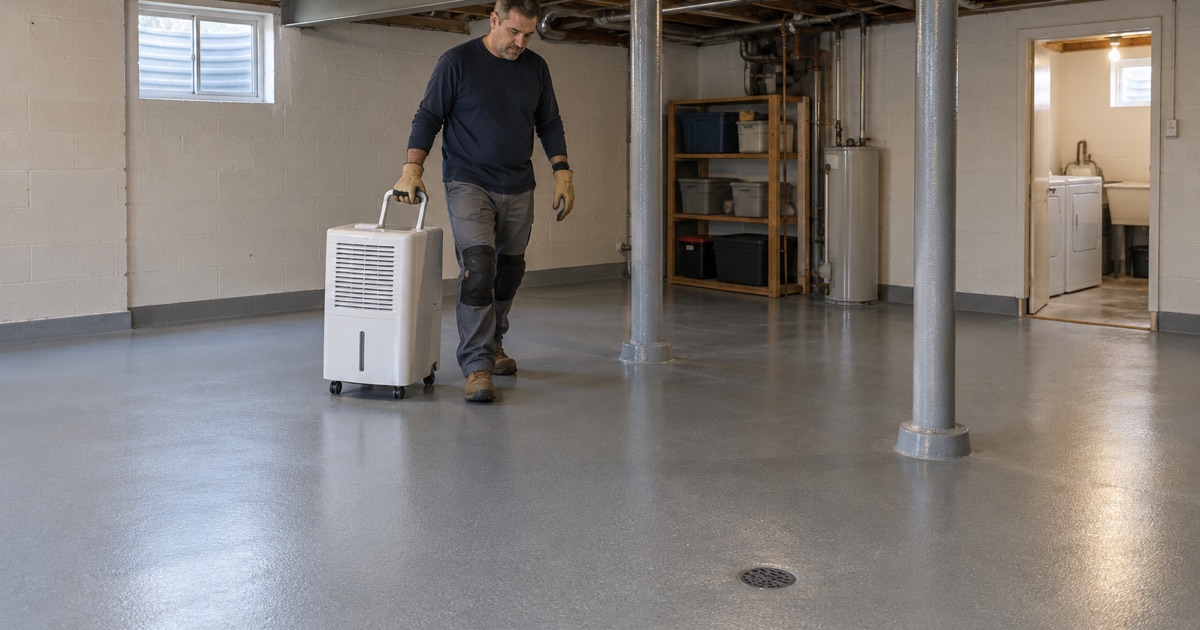
In humid summer weather, warm air meets a cool basement slab and condenses on it, leaving a damp surface that can look like a leak. That is a surface problem, and a dehumidifier often handles it. Vapor drive, in contrast, comes up through the concrete from the soil and will push against any coating from beneath.
Telling the two apart matters because the answers are different. We look at when the floor is damp, where, and what the tests show before recommending a coating or a primer.
Hydrostatic Pressure
When groundwater rises against the underside of a basement slab, it can force water and dissolved salts up through the concrete with enough pressure to lift any coating. A floor can look dry most of the year and still be under pressure in a wet spring or after heavy rain. We ask about seasonal water, look at the drainage, and do not coat a slab that is taking on water.
Reading the Basement Slab
Efflorescence and Old Paint
White powdery deposits on a basement floor are efflorescence, salts carried up by moving water. Basement floors also often carry old paint or sealers that are failing in patches. Both are removed by grinding, and both tell us something about the slab’s history that shapes the system we recommend.
We never acid etch a basement floor. Acid adds water and salts to a slab that may already have too much of both, and it leaves a weak, uneven profile for the primer.
Cracks, Joints and Settlement
Hairline shrinkage cracks are common and can be routed and filled before coating. Wider cracks, cracks with one side higher than the other, or cracks that let in water point to settlement or drainage problems that a coating will not fix. We read each crack and tell you plainly when a slab needs repair before it can be coated.
Sump Pits, Floor Drains and the Wall Line
The sump pit rim, the area around a floor drain and the joint where the floor meets the foundation wall are where water arrives first. We detail those areas by hand, keep drains open and functioning, and terminate the coating cleanly rather than running it into places that stay wet. A coating that is bonded everywhere except the edge will start peeling from that edge.
Choosing a Basement Floor System
Flake Floors for Busy Rooms
A vinyl flake broadcast in a 100% solids epoxy or polyaspartic base, sealed with a clear topcoat, gives a textured, speckled finish that hides dust and wear. It suits laundry rooms, storage areas, workshops and playrooms where the floor works hard. The texture also adds grip in stocking feet.
Solid Color and Metallic Finishes
Solid color coatings are clean and simple, and they work well in mechanical rooms and utility spaces. Metallic epoxy floors, with pigments worked by hand into clear resin, give a marbled look that suits a finished family room or bar area. Both need a flat, well-prepared slab, since every imperfection shows through glossy resin.
Home Gyms and Workshops
A home gym floor needs to handle dropped weights and sweat, and a workshop floor needs to shrug off oil, paint and dropped tools. We build those floors thicker and choose topcoats for impact and chemical resistance. For heavy free weights, rubber mats over the coating protect both the floor and the plates.
Finishing a Basement in New Berlin
The 7-Foot Ceiling Rule
New Berlin’s recreation room handout requires at least 7 feet from the basement floor to the underside of the finished ceiling, with lower clearances allowed under beams and ducts and for houses built before June 1, 1980. A thin coating leaves that measurement unchanged, while a built-up subfloor or sleepers can push a low basement under the line.
That makes a coating a practical choice where headroom is tight. We note the existing height during our visit so the finish never becomes the reason a ceiling falls short.
Permits for a Basement Finish
A coating applied to an existing slab is not on the city’s permit list. A basement finish that adds rooms needs building, electrical and plumbing permits, and starting work before the permit can double the fee. When the floor is part of a bigger project, we ask the Department of Community Development or confirm with your general contractor before scheduling.
What a Coating Is Not
A basement floor coating is not waterproofing, and it is not radon reduction. We do not sell it as a fix for water coming up through a slab, and we read the warranty exclusions out before the job is sold, with moisture from below named first. Knowing those limits up front is part of getting a floor that lasts.
Our Step-by-Step Basement Floor Epoxy Process
Step 1: Visit, Test and Proposal
We look at the slab, drains, sump and walls, run moisture tests and discuss how the room will be used. The proposal lists the primer, each coat, any broadcast and the finished thickness.
Step 2: Grinding and Repairs
The floor is ground with dust collected at the machine, old paint and efflorescence are removed, and cracks are repaired and ground flush. Nothing is rinsed down the floor drain.
Step 3: Primer and Coats
The primer, or a moisture-mitigation primer when testing calls for it, goes down first, followed by the base coat, any broadcast and the topcoat. Basements are cool, so we watch slab temperature and dew point through each step.
Step 4: Cure and Return
We confirm in writing when the floor can be walked on and when furniture and equipment can return, and leave simple care instructions. Running a dehumidifier through the humid months helps protect the new floor from summer condensation.
- 20+ Years on Concrete
- Moisture Testing in Every Scope
- Written Contract Before Any Deposit