New Berlin Epoxy Flooring installs flake epoxy floors in New Berlin, WI, serving surrounding cities including Hales Corners, West Allis, Greenfield, Brookfield and Waukesha. Over more than 20 years on concrete, the flake floor has become the system we install most often in garages, and for good reason: it hides dirt and wear, adds texture underfoot and builds a thicker floor than a plain color coat.
A flake floor is a layered system. Colored vinyl chips are broadcast into a wet base coat, the excess is scraped and vacuumed once the base has cured, and a clear topcoat locks it all in. The look comes from the flake, but the performance comes from what is underneath it, so every flake floor still starts with a ground slab, a moisture reading and repaired cracks and joints.
Your proposal names the base product, the flake blend and size, the topcoat and the finished thickness. That way two quotes for a flake floor can be compared on what they actually include.
How a Flake Floor Is Built
Preparation and Primer
We open the slab with diamond grinding or shot blasting to a profile suited to the primer, and we never acid etch. Cracks, spalls and joints are repaired and ground flush. Grinding dust is collected at the machine and leaves with us rather than being rinsed into a floor drain.
A penetrating primer seals the concrete and limits outgassing, the air that rises out of a warming slab and can leave pinholes in a fresh coat. Where moisture readings are elevated, a moisture-mitigation primer is used instead.
Base Coat and Broadcast
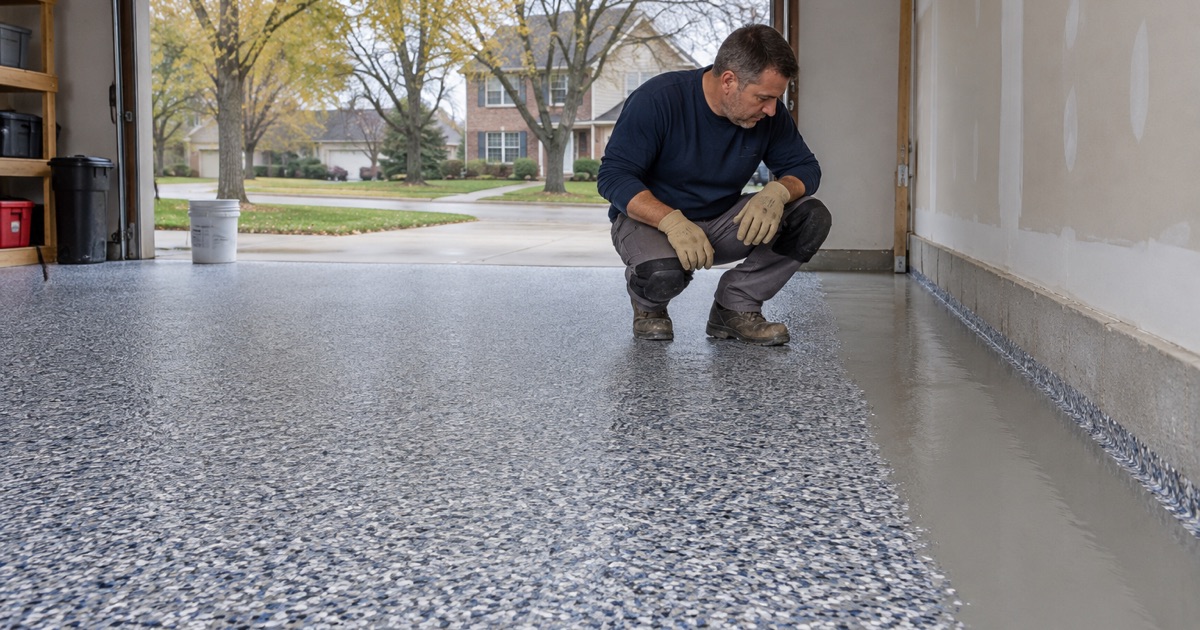
The base coat is usually a 100% solids epoxy or a polyaspartic, tinted to complement the flake. While it is wet, vinyl flake is broadcast by hand across the floor until the surface is fully covered. In a full broadcast, flake is thrown until no more will stick, which gives the most uniform look and the most build.
Once the base has cured, the loose flake is scraped and vacuumed. Scraping knocks down sharp edges so the topcoat can encapsulate the chips evenly.
Clear Topcoat
A clear polyaspartic or polyurethane topcoat seals the flake and takes the wear. These topcoats resist abrasion, chemicals and ultraviolet light much better than most epoxies, which can yellow in sunlight from an open garage door. One topcoat leaves more texture, while a second coat produces a smoother, easier-cleaning surface.
Choosing Flake Size, Blend and Coverage
Chip Size
Flake comes in several sizes, commonly from fine chips of about one-sixteenth of an inch to larger quarter-inch chips. Larger chips give a bolder, more granite-like look, while smaller chips read busier and more uniform from a distance. The size also affects texture, since larger chips leave a slightly coarser surface under a single topcoat.
Color Blends
Blends mix several colors of flake, often grays, tans, blacks and whites, with an accent color. Mid-tone, multicolor blends hide dirt, salt residue and tire marks best, which makes them practical for garages. Lighter blends brighten a basement or workshop, and darker blends give a dramatic look but show dust and white salt film more readily.
We bring physical samples to view in your own lighting. Colors on a screen rarely match what goes down on the floor.
Full Versus Partial Broadcast
A partial broadcast scatters flake over a colored base for a lighter, more open look and uses less material. A full broadcast covers the base completely, hides imperfections in the slab better and adds thickness and texture. For garages and other hard-working floors, we usually recommend full broadcast.
Where Flake Floors Work Best
Garages in a Salt-Belt Winter
Flake floors are a natural fit for New Berlin garages. The texture adds grip under snowmelt, the busy pattern hides salt residue and tire marks, and the topcoat resists rock salt and calcium chloride brine. Built to its rated thickness and allowed to cure fully, the system also resists hot tire pickup in the parking spots.
Curing is scheduled against slab temperature and dew point rather than a calendar date. An unheated garage may have to wait for spring so the coating cures properly.
Basements, Laundry Rooms and Workshops
In basements, a flake floor brightens the space, cleans easily and handles spilled detergent, paint and dropped tools. Basement slabs are moisture tested first, because vapor or hydrostatic pressure from below is the most common reason coatings fail, and moisture from below is the first exclusion on most coating warranties.
Commercial Restrooms, Locker Rooms and Shops
Flake systems also work in commercial restrooms, locker rooms, break rooms and light-duty shops. They are seamless and easy to sanitize, and the coating can be run up the wall as a coved base. In wet areas, we add fine aggregate to the topcoat for extra grip.
Flake Compared With Other Finishes
Flake Versus Quartz
Quartz broadcast floors use colored quartz aggregate instead of vinyl flake. Quartz is harder and gives a sandpaper-like texture, which suits commercial kitchens, ramps and heavy-traffic areas where slip resistance matters most. Vinyl flake is softer underfoot, easier to clean and more forgiving in a home.
Flake Versus Solid Color and Metallic
A solid color coating is simpler and cleaner looking, but it shows every speck of dust and tire mark. A metallic floor gives a decorative marbled look that suits living spaces more than a working garage. For most garages, flake is the most practical balance of appearance, grip and durability.
Flake Floors Versus Box Kits
Hardware-store flake kits usually pair a thin water-based epoxy with a light sprinkle of chips over an acid-etched slab. They look similar on day one but carry a fraction of the thickness and none of the preparation, which is why so many peel at the parking spots within a few winters. A professional flake floor is ground, repaired, built to a stated thickness and sealed with a real topcoat, and the difference shows after the second season of salt.
- 20+ Years on Concrete
- Moisture Testing in Every Scope
- Written Contract Before Any Deposit