
New Berlin Epoxy Flooring installs epoxy garage floors in New Berlin, WI, serving surrounding cities including Hales Corners, West Allis, Greenfield, Brookfield and Waukesha. With more than 20 years on residential concrete, we build garage floors as a system: a ground and repaired slab, a moisture reading, a high-solids base coat and a topcoat chosen for what a Wisconsin garage actually goes through.
That last part matters more here than in warmer states. From November to April, tires carry rock salt and calcium chloride brine into the garage every day, and the slush sits on the floor until it dries. Bare concrete soaks it up and scales, while a properly built coating keeps it on the surface where it can be squeegeed out the door.
Before we quote, we look at the slab in person, read the cracks, joints and any old paint or coating, and tell you plainly if the concrete needs repair or replacement first. Your proposal then names the product, every coat in the system and the finished thickness, so you can hold the finished floor up against the paperwork.
What Goes Into a Garage Floor Coating System
Mechanical Grinding to a Real Profile
Garage slabs are often finished smooth and sealed, and many carry years of oil, tire marks and old paint. We open the surface with diamond grinding or shot blasting to an ICRI concrete surface profile, typically CSP 2 or 3 for a garage system, and vacuum the dust at the machine. We never acid etch, because acid leaves salts and an uneven profile that a coating cannot rely on.
Grinding also tells us about the slab. Soft spots, delaminated patches and hidden sealers show up under the diamonds, and we deal with them before any resin is mixed rather than finding them as peeling spots a year later.
Repair of Cracks, Spalls and Joints
Shrinkage cracks are routed and filled, spalled areas near the door are patched with a repair mortar suited to coatings, and control joints are cleaned out and filled so the floor reads continuous. Where a crack shows the slab is moving, we explain what that means for any coating before going further.
The door apron, where salt water runs in, gets particular attention. It is usually the most deteriorated strip of a Wisconsin garage, and it is where a weak repair shows first.
Base Coat, Broadcast and Topcoat
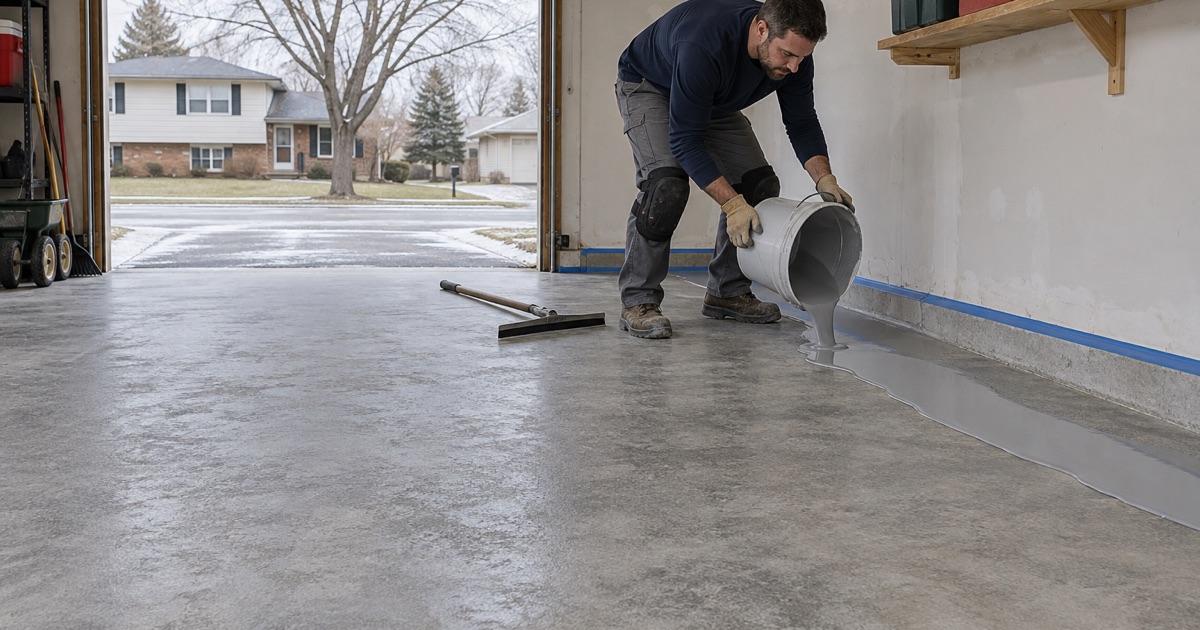
Our standard garage build starts with a penetrating primer, then a 100% solids epoxy or polyaspartic base coat into which vinyl flake or quartz is broadcast. After scraping and vacuuming the excess, a clear polyaspartic or polyurea topcoat seals the broadcast. Each layer and its thickness is written into the proposal.
A full flake broadcast hides tire marks and dust, adds texture underfoot and thickens the system. Solid color floors skip the broadcast and suit workshops where a plain, easily cleaned surface is the priority.
Problems a Garage Floor Has to Survive
Hot Tire Pickup
Tires come off the road hot, and a thin or soft coating softens under them and bonds to the rubber. When the car backs out after it cools, it pulls the coating off in tire-shaped patches. A properly prepared slab, a high-solids base and a hard topcoat at the specified thickness resist this, which is why parking spots are where cheap floors fail first.
We also let the system cure fully before the first vehicle goes in. Parking early on a coating that has not reached its working hardness is one of the easiest ways to start hot tire pickup on an otherwise sound floor.
Salt Brine and Deicer Damage
Calcium chloride and rock salt are corrosive to concrete and hard on lower-grade coatings. Our garage topcoats are chosen for chemical resistance to those deicers and to the oil, gasoline and antifreeze that also end up on a garage floor. The goal is a surface that brine sits on rather than soaks into.
Wisconsin’s dwelling code, SPS 321.203, already expects a garage floor to be concrete or another noncombustible material impermeable to petroleum products, at least 4 inches thick over at least 4 inches of granular fill, and sloped to drain. A coating does not replace those requirements; it protects a slab that meets them.
Moisture Vapor Under an Attached Garage
Under SPS 322.38, Wisconsin requires a vapor retarder under most dwelling floors but makes an exception for an unconditioned attached garage. That means many garage slabs sit on the base with no barrier, and vapor moving up can lift a coating. We test with a plastic sheet test to ASTM D4263 and calcium chloride testing to ASTM F1869 where it is warranted, and choose the primer from the result.
Timing a Garage Coating in a New Berlin Year
Slab Temperature and Dew Point
Resins need a minimum slab temperature to cure, and the slab must stay comfortably above the dew point so moisture does not condense on it during application. We measure the dew point spread at the slab surface on the day of work rather than relying on the forecast. If the numbers are not there, we move the date.
Coating into a falling slab temperature is also part of how we prevent outgassing. When concrete warms during application, air rising from its pores leaves pinholes and bubbles in the fresh coat.
Unheated Garages and Spring Scheduling
A heated garage can usually be coated in the middle of winter. An unheated garage in New Berlin often cannot reach and hold the temperatures resin needs until spring, and we would rather put it on the calendar for April than coat a cold slab that never cures properly.
Booking a spring date in winter has an advantage: the slab can be inspected and moisture tested ahead of time, so the work starts as soon as conditions allow. It also leaves time to clear the garage and plan where the cars will sit during the cure.
New Slabs Under Detached Garages
New Berlin requires a detached garage or other accessory building over 144 square feet to sit on a foundation or concrete slab. If you plan to coat that new slab, it needs time to cure and dry before any resin goes on, and a curing compound sprayed on the fresh concrete will have to be ground off. Talking about the coating before the pour saves a step later.
Our Step-by-Step Epoxy Garage Floor Process
Step 1: Slab Walk and Moisture Test
We inspect the slab, note cracks, joints, stains and any old coating, and run a moisture test. You get a written proposal naming the product, the system and the finished thickness, and a written contract before any deposit is taken.
Step 2: Grinding and Repairs
The garage is emptied, the slab is ground or shot blasted with dust collected at the machine, and cracks, spalls and joints are repaired and ground flush. Grinding dust is bagged and taken with us, and none of it is rinsed toward the floor drain or the driveway.
This is the longest and loudest part of the job, and it is also the part that decides whether the coating stays down. A garage that took a day to grind properly will outlast one that took an hour to etch.
Step 3: Primer, Base Coat and Broadcast
The primer is applied, followed by the base coat with flake or quartz broadcast to full coverage, then scraped and vacuumed once cured. We watch the slab temperature and dew point through the application and keep the door closed against drafting air.
On humid days we also watch for amine blush, a waxy film some epoxies form as they cure. It is washed off before the next coat, because a topcoat laid over blush can peel in sheets.
Step 4: Topcoat, Cure and Handover
The clear topcoat goes on at the specified thickness, and we confirm the walking and parking dates in writing along with care instructions for winter salt. Before we leave, we walk the floor with you and note anything that needs a touch-up.
The written contract, signed before any deposit, lists the products used and any warranty terms. That record is what you keep if a question ever comes up about what went down.
- 20+ Years on Concrete
- Moisture Testing in Every Scope
- Written Contract Before Any Deposit