
New Berlin Epoxy Flooring polishes concrete floors in New Berlin, WI, serving surrounding cities including Hales Corners, West Allis, Greenfield, Brookfield and Waukesha. Over more than 20 years on concrete we have ground warehouse slabs, retail floors, office lobbies and basements, and we know that a polished floor is only as good as the slab underneath and the honesty of the conversation about what that slab will look like.
Polished concrete is not a coating. We grind the slab with progressively finer diamonds, harden it with a lithium silicate densifier and refine it to the sheen you choose. Because the finish is the concrete itself, there is nothing to peel, blister or wear through in a traffic lane.
Before we quote, we look at the slab, read its cracks, joints, patches and any old coating or adhesive, and tell you how those will show once polished. Your proposal states the grind sequence, the level of aggregate exposure and the final sheen, so what you approved is what you get.
How Concrete Polishing Works
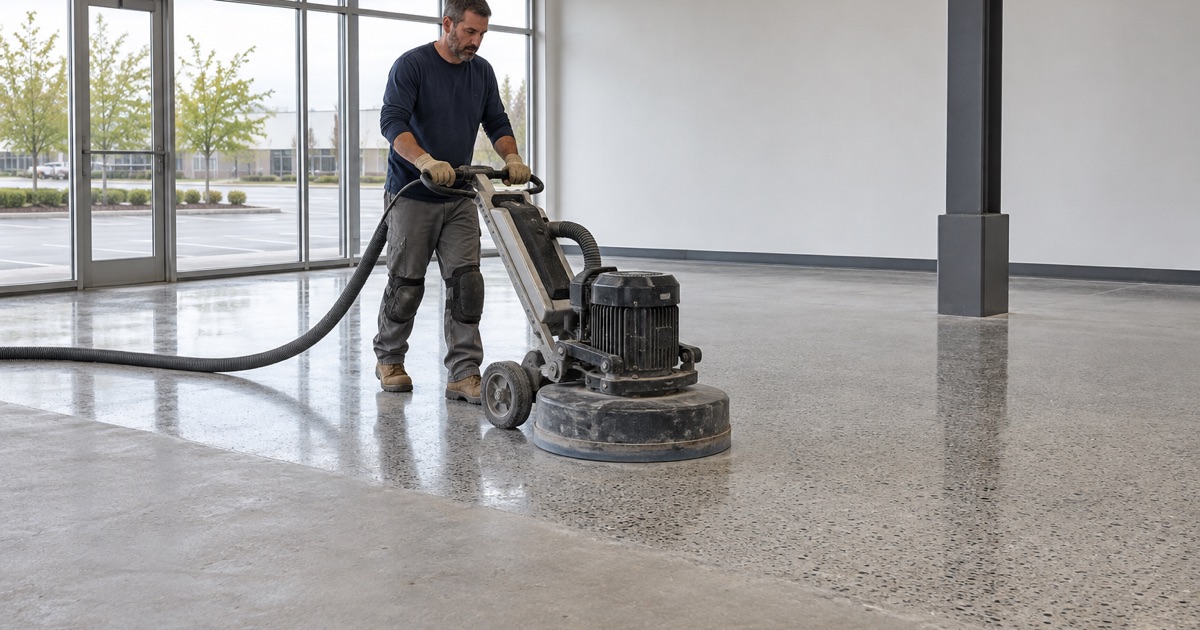
The Grinding Sequence
Polishing starts with coarse metal-bond diamonds that flatten the slab and remove coatings, adhesives and the weak surface layer. Each later pass uses a finer grit to remove the scratches of the one before, moving to resin-bond diamonds for the honing and polishing steps. Skipping a grit leaves scratches that show under raking light.
All of this is done with dust collection at the grinder, and on wet work the slurry is collected and bagged on site. None of it is washed toward a floor drain or out the door to a storm sewer.
Densifying the Slab
Partway through the sequence we apply a lithium silicate densifier. It reacts with the free lime in the concrete to form a harder, denser surface that takes a better polish and resists dusting and abrasion. On a soft slab, the densifier is what makes a durable polish possible at all.
We apply it at the stage the slab is open enough to absorb it, then continue polishing. Densifier applied too late, onto an already tight surface, sits on top rather than going into the concrete.
Guards and Stain Protection
After the final polish, many floors get a penetrating stain guard that helps resist oil, coffee and other spills. It is not a coating and does not build a film, so it does not change the floor’s character. It buys time to wipe up spills before they mark the concrete.
Choosing the Look Before We Grind
Aggregate Exposure
How deep we grind decides what you see. A light grind keeps the cream at the surface for a uniform look, a moderate grind reveals fine salt-and-pepper sand, and a deeper grind exposes larger stone. Deeper exposure takes more passes and costs more, and it also reveals whatever the slab holds, including uneven aggregate and old patches.
We agree the exposure level in writing, often after test-grinding a small area. Once concrete is removed it cannot be put back, so this is a decision made before the main grind, not during it.
Sheen Levels
Polished concrete can be finished from a flat, honed look to a high-gloss reflective surface. Higher sheens show more of the room in the floor and look striking in showrooms and lobbies. Lower sheens hide scuffs better and suit warehouses, workshops and entries.
Dyes, Borders and Saw Cuts
Penetrating dyes add color during the polishing sequence, and saw cuts can separate colors into borders, walkways or logos. Existing control joints can be filled and made part of the design. We plan these details before grinding so lines meet walls and doorways squarely.
Commercial Polished Concrete
Warehouses and Distribution Floors
Polished concrete suits warehouses because it holds up to forklift and pallet traffic without a coating to wear through in the aisles. The bright surface also reflects light around racking. Joints are cleaned and filled with a semirigid joint filler before polishing so hard wheels cross a supported edge instead of chipping the joint.
In an industrial park setting, including the New Berlin Industrial Park, we schedule around production with shift-break, weekend and shutdown-week windows. Large floors are phased so racking and inventory move in sections rather than all at once.
Retail, Showrooms and Offices
In retail and office space, polished concrete gives a clean, modern floor that handles heavy foot traffic and is easy to maintain. It works well with exposed ceilings and industrial interiors. We pay attention to the edges, columns and thresholds, where a polish job shows care or the lack of it.
Traction and Walking-Working Surfaces
OSHA’s walking-working surfaces rule, 29 CFR 1910.22, expects employers to keep floors clean, dry and free of hazards. Polished concrete helps by being easy to clean, but water, oil or dust on any smooth floor reduces traction. We set sheen and texture with the use in mind and recommend mats at entries where snowmelt comes in.
Residential Polished Concrete
Basements
A polished basement floor is durable and works well with area rugs and in-floor heat. Basement slabs sit in the ground, so we test moisture before polishing with relative humidity probes to ASTM F2170 or calcium chloride testing to ASTM F1869. Polishing does not stop water or vapor, and we do not suggest it as a fix for either.
If you are finishing a basement in New Berlin, polishing leaves floor-to-ceiling height unchanged, which matters because the city’s recreation room handout measures the required 7 feet from the basement floor. A finish that adds rooms will still need its own building permits.
Garages and Workshops
Polished concrete can work in a garage or workshop, but it is not our first choice where road salt arrives every winter. Calcium chloride brine and rock salt can still attack the concrete surface. For garages that see wet winter vehicles, a coating system usually protects the slab better, and we will tell you that rather than polish a floor that will scale.
New Home Slabs
If a new slab is going to be polished, the best results come from planning before the pour, including the mix, the finishing method and protection during construction. Curing compounds, drywall mud and paint spills all affect the polish. Talking to us early means fewer surprises when the grinder arrives.
Our Step-by-Step Polished Concrete Floors Process
Step 1: Slab Assessment and Test Grind
We walk the slab, map cracks, joints, patches and any coating or adhesive, and check moisture where it matters. On floors where the look is uncertain, we grind a small test area so you can see the aggregate and color before deciding. The proposal then sets out the grind sequence, exposure, sheen and any dye.
Step 2: Removal, Flattening and Repairs
Coatings, adhesives and high spots come off with metal-bond diamonds, and cracks and joints are filled with materials suited to polishing. Repairs will show in a polished floor, so we discuss in advance how visible they will be rather than promising they will vanish.
Step 3: Densify, Hone and Polish
The densifier goes on once the surface is open, and we continue through the honing and polishing grits to the agreed sheen. Edges and corners are done with smaller machines so the perimeter matches the field.
Each pass is checked under raking light before moving on. A scratch left by a skipped or rushed grit is far easier to fix at that stage than after the final polish.
Step 4: Guard, Clean-Up and Care Plan
A penetrating stain guard is applied if specified, the floor is cleaned, and all collected dust and slurry leave with us. You get a simple care plan covering daily cleaning and when periodic burnishing makes sense.
- 20+ Years on Concrete
- Moisture Testing in Every Scope
- Written Contract Before Any Deposit