New Berlin Epoxy Flooring installs industrial epoxy flooring in New Berlin, WI, serving surrounding cities including Hales Corners, West Allis, Greenfield, Brookfield and Waukesha. In more than 20 years on concrete we have coated machine shops, fabrication bays, warehouses and distribution floors, and we have learned that an industrial floor is judged by how it looks after a year of forklift turns, not on the day it is finished.
Industrial floors fail for predictable reasons: thin coatings in heavy traffic lanes, open joints that chip under hard wheels, chemicals the coating was never chosen for, and moisture from below. We plan against each of those before work starts, and our proposal names the product, the system build and the finished thickness for every area of the floor.
Systems Matched to the Work
High-Build and Slurry Epoxy
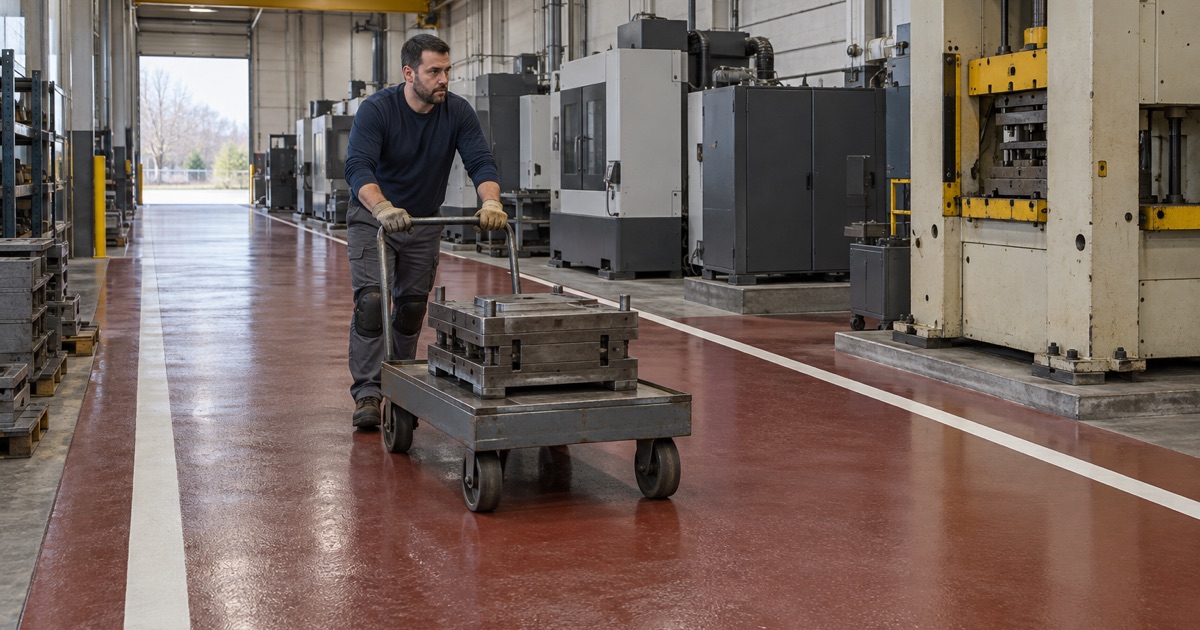
Forklift aisles, dock approaches and assembly areas need thickness. High-build 100% solids epoxy and trowel-applied slurry systems give an industrial floor the body to absorb impact and abrasion without wearing through to bare concrete. Quartz aggregate broadcast into the build adds texture and further hardness where grip and wear both matter.
Lighter-duty areas such as storage rooms, offices within the plant and mezzanines can use thinner systems. Matching thickness to traffic keeps cost where it does the most good.
Chemical-Resistant Coatings
Coolants, cutting oils, hydraulic fluid, solvents and cleaning chemicals each attack coatings differently. We ask what actually lands on your floor and choose chemical-resistant or novolac epoxies and topcoats to suit, rather than offering one product for every plant.
Urethane Cement for Heat and Washdown
Where floors see hot water washdown, steam cleaning or thermal shock, epoxy can crack or delaminate. Urethane cement is built for those conditions and is the usual answer in food production and some process areas. We recommend it where it fits and say plainly when epoxy is the wrong material.
Joints, Racking and Battery Rooms
Filling Joints Before Wheels Cross Them
Open control and construction joints chip at the edges every time a hard forklift or cart wheel crosses them, and a coating alone cannot prevent that. We repair damaged edges and fill joints with a semirigid joint filler before coating, so wheels roll across a supported surface. It is one of the least expensive steps on an industrial floor and one of the most important.
Aisle and Lane Marking
Where mechanical handling equipment is used, OSHA’s materials handling rule, 29 CFR 1910.176(a), requires sufficient safe clearances for aisles and says permanent aisles shall be appropriately marked. It sets no stripe width or color, so the layout comes from the operator. On floors where forklifts, automated vehicles and people share space, the line plan belongs in the floor specification, especially in plants that run around the clock with no routine shutdown for restriping.
Battery Charging Areas
OSHA’s powered industrial truck standard, 29 CFR 1910.178(g), requires battery charging installations in designated areas with facilities for flushing and neutralizing spilled electrolyte, fire protection, protection of charging apparatus from damage by trucks, and ventilation. The floor in that area is where sulfuric acid electrolyte lands and gets washed down, so it needs a coating chosen for repeated acid contact rather than the system used across the rest of the shop.
Preparation on an Industrial Slab
Shot Blasting and Diamond Grinding
Industrial slabs often carry oil contamination, old coatings, curing compounds and a weak surface layer. We open them by shot blasting or diamond grinding to the ICRI concrete surface profile the system calls for, often a heavier profile for thick slurry systems. We never acid etch, which leaves residue and an inconsistent surface on a floor that has to carry real loads.
Oil-soaked areas around machines may need degreasing and deeper grinding before they will accept a coating. We find those areas during the walk-through rather than after the primer refuses to bond.
Moisture and Slab Condition
We test moisture with calcium chloride testing to ASTM F1869 or relative humidity probes to ASTM F2170, and read cracks, settlement and joint condition before quoting. If parts of the slab need repair or replacement first, we say so. Moisture from below heads the exclusion list on most coating warranties, and we go over those exclusions before the job is sold.
Dust and Slurry Control
Grinding dust is collected at the machine with industrial vacuums, and any slurry is collected and bagged on site. None of it goes down a floor drain or out to a storm sewer. That keeps adjacent work areas cleaner and keeps concrete fines out of your plumbing.
Scheduling Around Production
Shift Breaks, Weekends and Shutdown Weeks
Industrial park floors, including those in the New Berlin Industrial Park, rarely get a long shutdown. We schedule work in shift breaks, weekends and planned shutdown weeks, phase large floors into zones, and use fast-cure systems where the return-to-service window is short. Each zone is handed back on a date agreed in writing, so you can plan inventory and equipment moves around it.
We also plan the sequence with your maintenance and safety staff. Fire lanes, emergency exits and forklift routes around the work zone are agreed before the first machine is unloaded, so the rest of the building keeps operating safely.
Cure Conditions in a Working Plant
Plants are not always heated evenly, and dock doors open and close all day. We measure slab temperature and the dew point spread at the surface in each zone and adjust the schedule or the product when conditions are marginal. A floor that cures properly the first time costs far less than one that has to be ground off and redone during the next shutdown.
Keeping the Floor Safe to Walk
OSHA’s walking-working surfaces rule, 29 CFR 1910.22, expects floors to be kept clean, dry and free of hazards. A seamless, textured, easily cleaned floor makes that easier to meet day to day. We set texture by area, with more grip at wash stations, dock plates and ramps and a smoother finish where carts and pallets need to roll easily.
- 20+ Years on Concrete
- Moisture Testing in Every Scope
- Written Contract Before Any Deposit