
New Berlin Epoxy Flooring handles concrete floor repair in New Berlin, WI, serving surrounding cities including Hales Corners, West Allis, Greenfield, Brookfield and Waukesha. For more than 20 years, repair has been part of nearly every floor we coat, because cracks, spalls and broken joints are what decide whether a coating lasts. We also repair floors that will stay bare, from garage aprons eaten by road salt to warehouse joints chipped by forklift wheels.
Good repair starts with reading the slab honestly. A hairline shrinkage crack and a crack from a settling slab look similar on the surface and need completely different answers. Before we quote, we look at every crack, joint and patch, check for moisture, and tell you plainly when a slab needs replacement rather than another patch.
Every repair is ground into a mechanically prepared surface rather than smeared over dust and old sealer. We never acid etch, and grinding dust and slurry are collected on site rather than washed into a floor drain or storm sewer.
Cracks: Reading Them Before Filling Them
Shrinkage Cracks
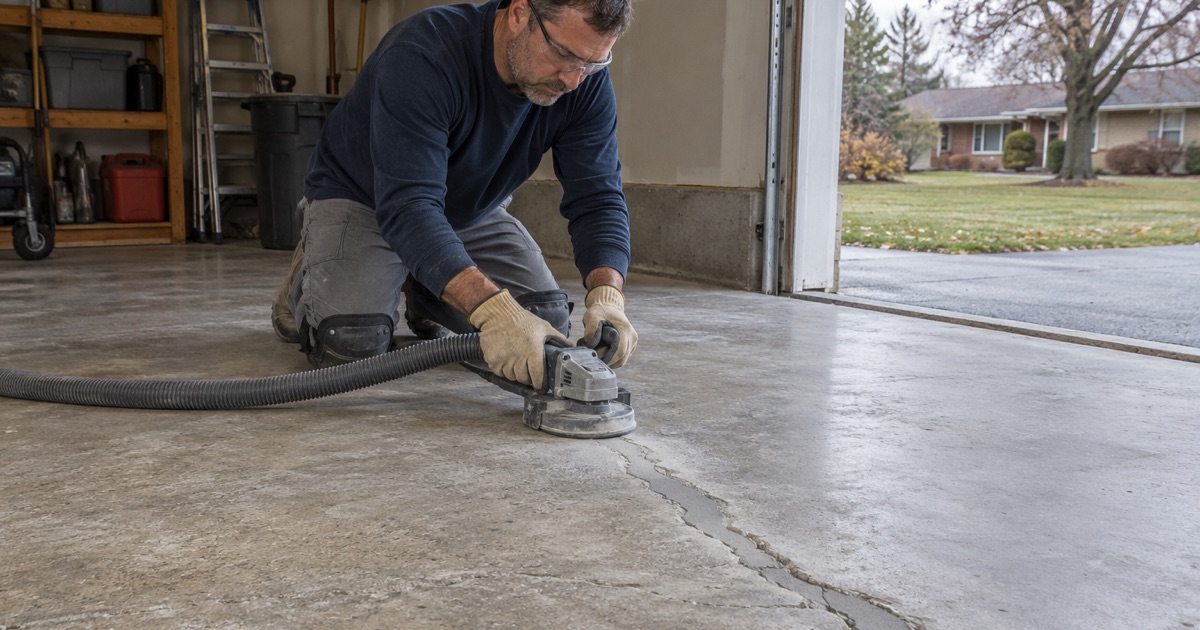
Most concrete slabs develop shrinkage cracks as they cure and dry. They are usually fine, random or running from the corners of openings, and they rarely affect the slab’s strength. We route them open so the repair material has something to grip, fill them with an epoxy or polyurea crack filler, and grind them flush so they disappear under a coating.
Left unfilled, these cracks collect dirt and water and are the first place a coating cracks or a bare slab starts to deteriorate. Filling them is quick and inexpensive.
Moving and Structural Cracks
Cracks with one side higher than the other, cracks that keep widening, or cracks that let water in point to settlement, frost movement or drainage problems underneath. A filler will not hold a moving crack, and coating over one simply moves the crack into the new floor. We tell you when a crack is a symptom and when the cause needs a different trade before any floor work is worth doing.
Control Joints
Control joints are saw cuts placed to make the slab crack where it is planned. In garages and homes we usually clean and fill them so the floor reads continuous, or honor them as part of a decorative layout. In plants and warehouses, joints are filled with a semirigid joint filler before coating so forklift and cart wheels roll across a supported edge instead of breaking it down.
Spalls, Pits and Scaling
Spalled Edges and Pop-Outs
Spalls are chunks of concrete broken out of the surface, often along joints, at the garage door or where something heavy was dropped. Pop-outs are small cone-shaped holes where an aggregate particle near the surface failed. We cut back to sound concrete, prime the area and rebuild it with an epoxy or cementitious repair mortar suited to the coating that will follow.
Salt Scaling on Garage Floors
Scaling is the flaking or peeling of the top layer of a slab, and in Wisconsin it is most often caused by rock salt and calcium chloride brine carried in on tires. The brine soaks into the surface, and freeze-thaw cycles break it apart. We grind off the loose material, rebuild low areas with a resurfacing mortar and, in most cases, recommend a garage coating to keep the brine on the surface from then on.
The door apron is usually the worst area because it sees the most water and the most temperature change. It gets extra attention during repair.
Pitting and Worn Surfaces
Old industrial and garage slabs can be pitted, dusting or worn down to the aggregate. A densifier can harden a dusting slab that will stay bare, while a slurry or self-leveling resurfacer can restore a flat working surface before a coating. We choose based on how the floor will be used afterward.
Slabs That Need More Than a Patch
Settled, Heaved and Broken Sections
When sections of a slab have sunk, lifted or broken into pieces, patching rarely lasts. The base underneath may have washed out, frozen or been poorly compacted. We tell you when replacement is the right answer, and we do not sell a coating as a fix for a slab that is failing structurally.
Replacing a Garage Slab
Wisconsin’s dwelling code, SPS 321.203, expects a garage floor to be concrete or another noncombustible material impermeable to petroleum products, at least 4 inches thick over at least 4 inches of granular fill, and sloped to drain. A replacement slab has to meet that standard. New Berlin’s permit table does not list a permit for a garage slab replacement and tells owners to ask, so we contact the Department of Community Development before anything is scheduled.
If the new slab will be coated, we plan for it before the pour, because curing compounds and a short drying time both affect when and how a coating can go on.
Moisture and Water Problems
Some floors crack, scale or lose their coatings because of water below the slab. Efflorescence, damp edges and hydrostatic pressure in a basement are signs that moisture is part of the problem. We test with the ASTM D4263 plastic sheet test, calcium chloride testing or relative humidity probes, and we are clear that a repair or coating is not a cure for water coming up through a slab.
Repair Before a Coating
Most of our repair work happens as the first stage of a coating job. Cracks, spalls and joints are repaired after grinding, then the repairs are ground flush so the primer and base coat go down over one continuous surface. Repair materials are chosen to be compatible with the coating system named in the proposal, so the patch and the floor move and cure together.
Skipping repair is one of the most common ways a new coating fails early. A coating bridged over an open crack or a loose spall cracks along the same line within months, and a warranty rarely covers it.
- 20+ Years on Concrete
- Moisture Testing in Every Scope
- Written Contract Before Any Deposit